Michelle Yeoh Went Platinum Bob at Chanel — But What Does Her Face Geometry Actually Ask For? We Ran the AI (With Before/After)
On July 7, 2026, Michelle Yeoh walked into Chanel's Paris Haute Couture show and detonated a decade of visual expectations. Gone was the long, dark, center-parted hair that has been practically part of her signature — in its place, a platinum blonde pageboy bob. Entertainment press covered it within hours, and for good reason: this is one of the most dramatic celebrity hair transformations of the year.
Which raises the question we always ask at CutMuse: forget the drama — what does her facial geometry actually ask for? Was the long hair she wore for decades the optimal answer? Is the new bob? Or is it something else entirely?
We did what we do: we ran her face through our AI visagist — the same analysis engine that processes reader photos every day — using her classic look as the reference. Then we had the AI generate what its own top recommendation would look like on her. Here's the full breakdown.

The reference: Yeoh's classic long, straight, center-parted style. Photo: Harald Krichel, Wikimedia Commons (CC BY-SA 4.0).
The face analysis: what the AI sees
Strip away the red carpet and the couture, and Yeoh's facial geometry reads like this:
- Face shape: oval. Balanced forehead, cheekbones, and jawline, with a slightly wider forehead tapering gently toward the chin. In visagism, this is the reference shape — the one every other face-shape strategy tries to visually approximate.
- A softly rounded jawline. No hard angles to correct or conceal, which removes one of the most common constraints in haircut selection.
- Straight, fine-to-medium hair in a deep dark brown — hair that holds sleek lines effortlessly but needs deliberate work to hold volume.
- Current style on record: long, straight, center-parted. The look she's worn through most of her career.
An oval face has one defining property: it doesn't need correcting. Where other face shapes use a haircut to add width, subtract length, or soften angles, an oval face grants its owner something rare — latitude. Most styles can work. The question stops being "what fixes my proportions?" and becomes "what story do I want the cut to tell?"
Why the classic long hair genuinely worked
Our AI's verdict on her signature style was unambiguous: it works. Three reasons, in visagism terms:
1. It preserves natural balance. A center part on an oval face splits the face symmetrically without adding width or height where none is needed. The proportions stay exactly as the bone structure drew them.
2. Sleekness matches the features. Straight, polished lengths echo refined, low-contrast facial lines. There's no texture fighting the face — the hair reads as an extension of it.
3. Length elongates — within budget. Long hair adds a subtle vertical pull. On a short or round face that's a correction; on a balanced oval it's a stylistic choice the face can comfortably absorb.
Not sure about your face shape?
Find out free from one photo, with tips on the haircuts that suit it.
So her decades-long signature wasn't inertia. It was a geometrically sound answer. That matters for what comes next.
The experiment: the AI's own recommendation, rendered
Given a face that needs no correction, our AI didn't recommend a rescue — it recommended a refresh: long layers with soft waves. Face-framing layers with subtle, soft waves that add volume and movement while keeping the length. We had the AI generate it — same face, same photo, only the hair changed:
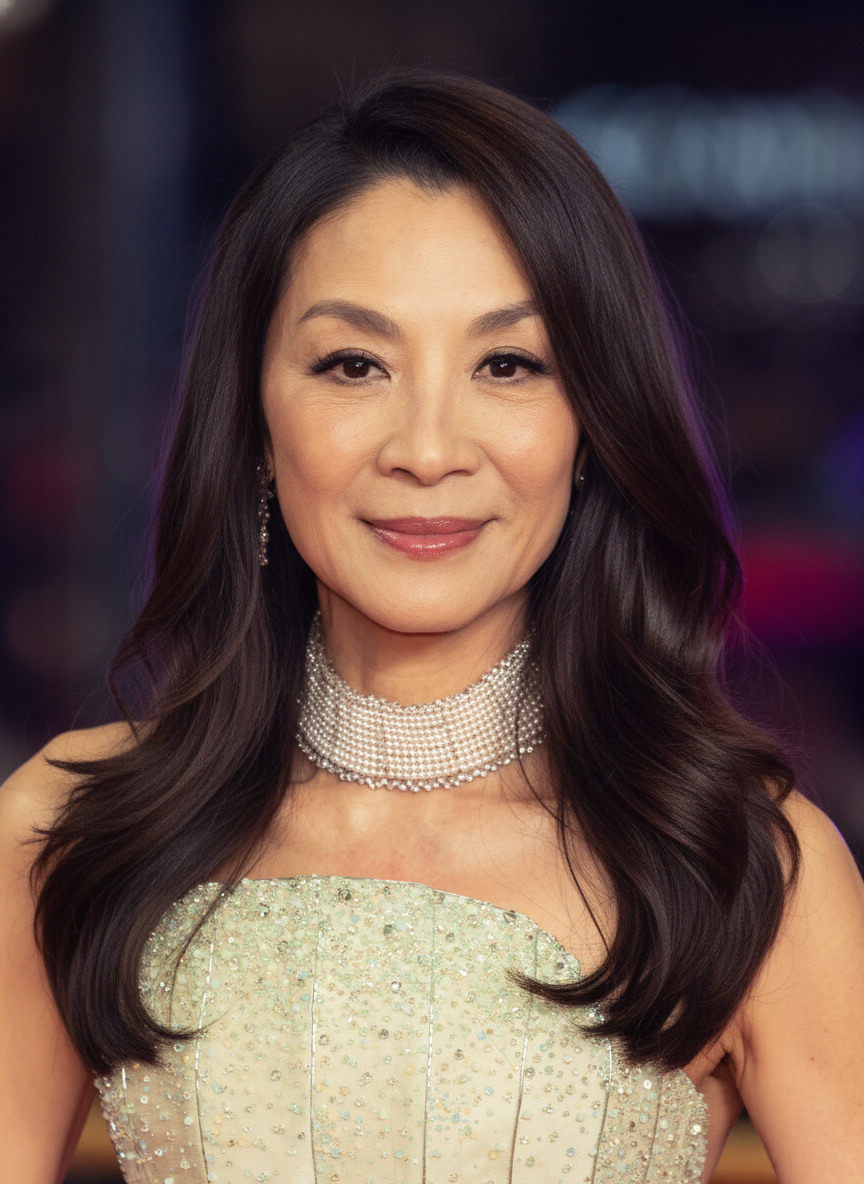
AI visualization generated with CutMuse's style engine. This is not a real photo.
What changes, in visagism terms:
- Movement replaces polish. The waves introduce mid-face volume and a dynamic silhouette that the sleek version deliberately suppresses. Fine-to-medium hair benefits most from this — layering prevents lengths from reading flat or heavy.
- The frame softens further. Face-framing layers draw gentle diagonals around the cheekbones, adding vibrancy without altering the underlying proportions.
- The story shifts, not the structure. Sleek-and-straight reads composed and precise; layered waves read warm and kinetic. Same geometry, different narrative.
The AI also floated two alternates: a sleek low ponytail with side-swept bangs (to spotlight the bone structure and neckline) and — notably — a medium-length blunt cut with a deep side part, which it praised for adding "a modern, chic look" with asymmetry and volume.
So where does the platinum pageboy bob land?
Look at that second alternate again. A medium-length blunt cut is, structurally, a longer cousin of exactly what Yeoh debuted in Paris. The pageboy bob keeps weight in a clean blunt line, frames the jaw, and trades vertical length for graphic shape — all moves an oval face can absorb without penalty.
The platinum color is the bigger gamble than the cut. High-contrast color changes how edges read: light hair against darker features sharpens every line of the cut, which is why the bob looks so architectural in the Chanel photos. On a face with harsh angles, that amplification could work against you. On a balanced oval, it simply turns the volume up.
The verdict
Honest answer: her classic long hair was already optimal — and the new bob works too. That's not a dodge; it's the core lesson of oval-face visagism. When your geometry doesn't need correcting, a dramatic transformation isn't a risk to your proportions — it's a change of story. Yeoh spent decades telling one story with geometrically sound hair, and switched to another without breaking a single rule.
The catch: most faces are not oval. The same pageboy bob that reads architectural on her can add unwanted width on a round face or exaggerate a strong jaw on a square one. Her latitude is earned by her geometry — which means copying the cut without knowing your own is exactly the mistake visagism exists to prevent.
✂️ Find out what your face asks for. Upload a front and a profile photo to CutMuse and our AI visagist picks the 5 haircuts that work with your geometry — and renders each one on your own face, just like we did here. If you don't like the results, you can request a refund.
Disclosure: the "after" image in this article is an AI-generated visualization created for editorial and educational commentary on hairstyle-face compatibility. It does not depict a real photograph. Reference photo by Harald Krichel via Wikimedia Commons, CC BY-SA 4.0.
Related Articles
Jennifer Lawrence Just Went Darkest in 14 Years — Does Her Hair Actually Fit Her Face Shape?
Jennifer Lawrence just went darkest in 14 years. We ran her face through CutMuse's AI visagist to see what actually fits her face shape.
Teyana Taylor's Extreme Ginger Extensions Went Viral at Couture Week — But Our AI Says Her Face Wants the Opposite
Teyana Taylor wore extreme ginger extensions at couture week. We ran her face through AI — and the recommended cut is nearly the opposite.
Maura Higgins Just Chopped Off Her Signature Long Hair for a Pixie Cut — Here's What Our AI Says
Maura Higgins traded her long hair for a choppy pixie at Paris Couture Week. We ran her classic look through CutMuse's AI visagist to see what fits her face.
Kim Kardashian's 'Beach Babe Bob' Is Everywhere. Our AI Says Her Face Can Pull Off Almost Anything — Here's Why Yours Might Not
Kim K's platinum beach babe bob is summer 2026's most-copied cut. Our AI visagist explains why it works on her — and why it might not work on you.
Does Timothée Chalamet's Signature Hair Actually Fit His Face? We Asked Our AI (With Before/After)
Chalamet's curls are the most-copied men's cut of the decade. We ran his face through CutMuse's AI to see if they fit his face shape — with an AI before/after.
Octopus Haircut by Face Shape (2026): Will the Viral Layered Cut Suit You?
The octopus haircut is one of 2026's most-searched cuts. See which face shapes it flatters and how to adapt it with AI face-shape analysis.